

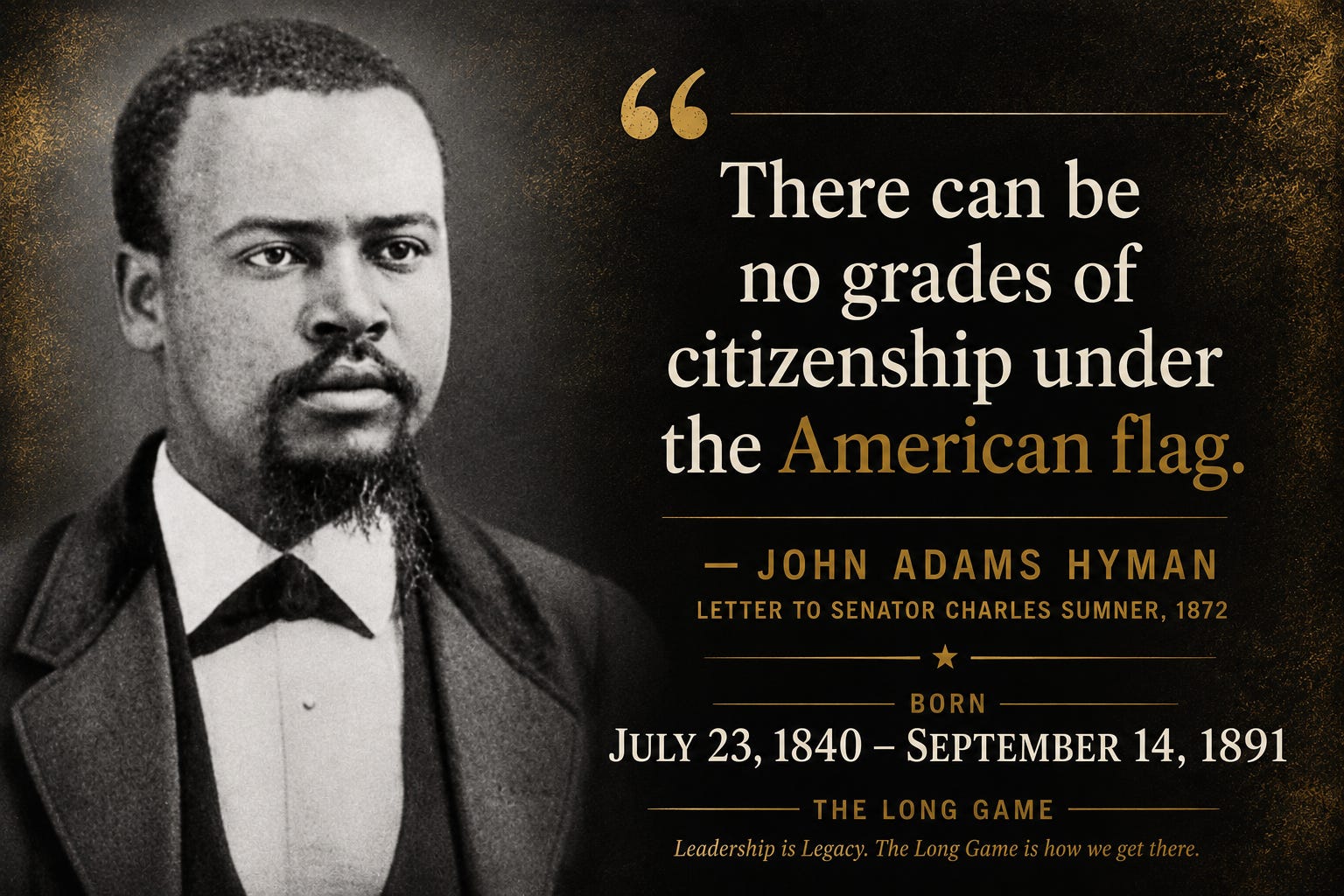
Determination defined John Adams Hyman's life.
Hyman was born in North Carolina on July 23, 1840, before the 13th Amendment was ratified, abolishing slavery. He grew up enslaved but developed a fierce desire for knowledge. He was determined to learn to read. His eagerness to learn and his attempts to read books led to him being sold eight times and moving from North Carolina to Alabama. Still, he persevered.
When the 13th Amendment was ratified in 1865, Hyman was 25 years old and a free man. He returned to his family in North Carolina and enrolled in school to complete his elementary education. He continued to expand his horizons by becoming a landowner, a Mason, and a community leader during the post-Civil War period. By 1868, he was an active member of the Republican Party. Despite threats and intimidation by the Ku Klux Klan, the people elected Hyman and 132 other Republicans to the Constitutional Convention that drafted North Carolina’s new constitution. That constitution called for public education accessible to all students and voting rights for African American men.
After the Convention, Hyman’s political career advanced. He was elected to the North Carolina State Senate from Warren County and served until 1874. In 1874, during his second campaign for Congress, he defeated the Democratic candidate, becoming the only Republican from North Carolina elected to Congress that year. However, the election was contested locally, and his term ended before he was officially seated. He ran again in 1876 and 1878 but was defeated both times.
After his defeat, Hyman returned to North Carolina to farm and operate a grocery and liquor store in Warrenton. Controversy followed him. Eventually, he left Warrenton and moved back to Washington, D.C., where he held various minor appointed positions, including special deputy collector of internal revenue, and roles in the U.S. Post Office and the U.S. Department of Agriculture. He died at age 51 on September 14, 1891.
John Adams Hyman understood that freedom was not a finish line. It was an invitation to begin. From learning to read in secret while enslaved, to helping write a new state constitution, to serving in Congress, he refused to let the circumstances of his birth define the limits of his future. He played The Long Game—not because the road was easy, but because self-determination mattered more than each obstacle placed in his path.