

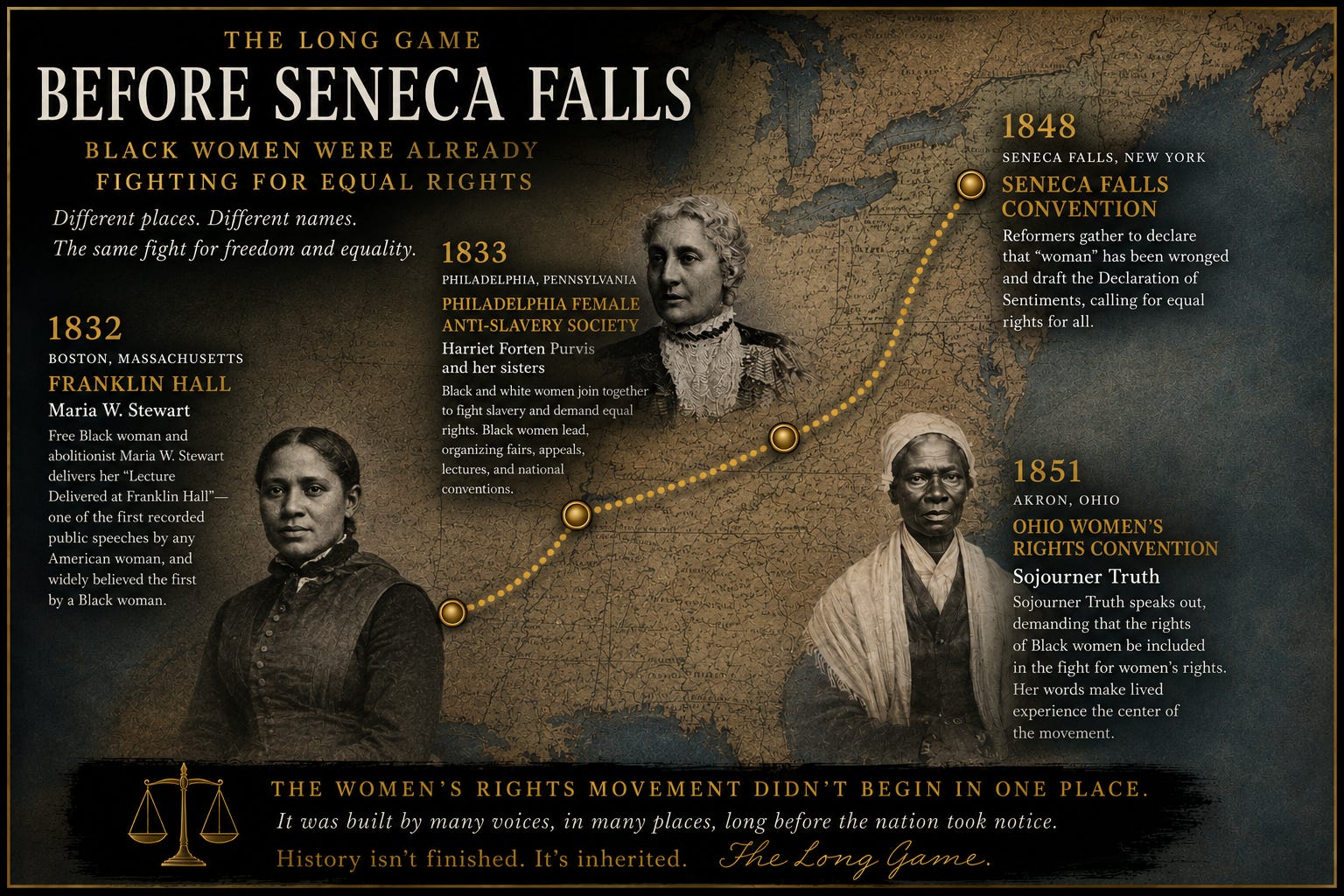
On July 19, Americans commemorate the Seneca Falls Convention as the beginning of the organized women’s rights movement. But sixteen years earlier, in a Boston lecture hall, a free Black woman had already stood before a public audience demanding equal rights for her people.
July 19 and 20, 1848, reformers met at Seneca Falls to declare that “woman” had been wronged. But even before this, Black women were already fighting for their rights in different places and under different names. Many histories and public institutions mark these two days as the start of the organized women’s rights movement in the United States, noting that the convention “served as the framework” for later suffrage campaigns. The Declaration of Sentiments, written at the convention, demanded rights that had long been denied and stated that “all men and women are created equal.”
Still, not all women were present in that origin story. Frederick Douglass, the only Black participant mentioned in the records, spoke in favor of women’s suffrage and signed the resolutions. Black women are only mentioned in general terms, not as named delegates or speakers. While Seneca Falls was important, it mainly formalized a white women’s rights movement at a time when Black women were already fighting for equal rights in their own ways.
Seneca Falls is just one part of a bigger story. Black women fought for equal rights on two fronts: against racism and against sexism. They often did this through their own institutions and strategies, working alongside but not always within white-led women’s rights groups. This history is not just a later addition to a movement that started at Seneca Falls. Instead, it is a continuous, community-focused struggle that began before 1848 and continued, even as white suffragists moved away from racial justice after the Civil War.
Franklin Hall – Maria W. Stewart, 1832
More than fifteen years before Seneca Falls, Maria W. Miller Stewart, a free Black woman, took the stage in Boston to demand equal rights. On September 21, 1832, she gave her “Lecture Delivered at Franklin Hall” to an antislavery audience. This was one of the first recorded public political speeches by any American woman and is widely regarded as the first recorded public political lecture by a Black American woman.
In her lecture, Stewart asked, “Who shall go forward, and take off the reproach that is cast upon the people of color? Shall it be a woman?” She answered, “If it is thy will, be it even so, Lord Jesus!” She spoke out against slavery, racism, and the economic barriers that kept free Black men and women from the “rights and privileges of free citizens.” She said, “The whites have so long and so loudly proclaimed the theme of equal rights and privileges, that our souls have caught the flame also, ragged as we are.” In this way, Franklin Hall became an early place for a Black feminist political tradition, years before anyone gathered in New York to say that “woman” had been wronged.
This is not just a side story. It’s an earlier chapter in the same struggle.
Akron – Sojourner Truth, 1851
Three years after Seneca Falls, Sojourner Truth spoke at the Ohio Women’s Rights Convention in Akron, making her life and experiences central to the women’s rights debate. She was born into slavery in New York and later freed herself. During the 1840s and 1850s, she traveled as a preacher and antislavery speaker, helping to bring attention to the issues discussed in Akron.
In her 1851 speech, published in the Salem Anti‑Slavery Bugle, Truth told the audience, “I have as much muscle as any man, and can do as much work as any man. I have plowed and reaped and husked and chopped and mowed…” She then asked why a woman like her should be denied rights. Speaking about intellect, she said, “If my cup won’t hold but a pint, and yours holds a quart, wouldn’t you be mean not to let me have my little half‑measure full?” These words show that the Akron event was a direct part of her fight for equal rights.
Truth’s speech made it clear that any movement for “woman” must include the work, struggles, and strength of Black women, not just the concerns of white women. If Seneca Falls said women deserved rights, Akron, through Truth, demanded that Black women be included in that call.
Philadelphia – Harriet Forten Purvis and her sisters, 1833
During the years before the Civil War, Black women in cities like Philadelphia were creating organizations that combined the fight against slavery with the push for women’s rights. This happened long before national suffrage groups existed. Harriet Forten Purvis, whose parents, James and Charlotte Forten, were leading Black abolitionists, was one of these leaders. Philadelphia is an example of how these efforts became organized.
In 1833, Harriet Forten Purvis joined with her mother, sisters, and Lucretia Mott to establish the Philadelphia Female Anti‑Slavery Society, often described as the city’s first women’s abolitionist group for Black and white members. Within that society, Black and white women organized fairs, issued appeals, and hosted lectures to attack slavery and argue for racial equality, with Black women in leadership roles. The work makes Philadelphia a clear example of the movement described above.
Later, Harriet became known as “a powerful nineteenth‑century voice for equal rights for all—including women.” She helped people escape slavery, spoke out against segregation, helped organize national women’s rights conventions, and joined the American Equal Rights Association alongside leaders such as Sojourner Truth and Sarah Remond. Her work shows that Black women’s rights efforts always connected race and gender, even when national white suffrage groups did not.
Why this matters on July 19
Celebrating July 19 as the anniversary of Seneca Falls reminds us that women once had to gather and protest just to be heard as citizens. This date is important. But if we stop the story there, we treat a partial beginning as the whole story and miss the main point: Black women’s fight for rights started before Seneca Falls and continued alongside it. If we do not recognize this, we risk telling a history where Black women only appear when they join white-led movements, instead of as leaders of their own rights traditions.
Franklin Hall shows us that in 1832, a Black woman stood before a public audience, defending her right to speak and demanding equal rights for her people. Akron shows us that in 1851, a Black woman insisted that any real discussion about women’s rights must include the work, pain, and strength of Black women. Philadelphia shows that Black women were organizing biracial abolitionist groups and fighting for suffrage and racial justice from the 1830s onward, even as national movements shifted around them. Together, these places reveal the connections throughout this history.
When we say the women’s rights movement started at Seneca Falls, we should also remember that Black women’s fight for equal rights did not start there—and did not end when white suffragists won in 1920. Their struggle has always been a continuous, community-focused fight on two fronts, often happening alongside, not inside, the well-known institutions of the time. Honoring Seneca Falls on July 19 can also mean honoring Franklin Hall, Akron, and Philadelphia—and making sure that when we talk about “women,” we include all women.
History rarely begins where we are taught to look. Long before Seneca Falls, Maria Stewart had already stepped onto a public stage. Soon afterward, Sojourner Truth demanded that Black women be seen within the struggle for women’s rights, and Harriet Forten Purvis was building organizations that joined racial justice and women’s equality into a single cause.
Their stories remind us that The Long Game of democracy has never belonged to one convention, one movement, or one generation. Every generation inherits more than a date—it inherits voices waiting to be heard.
The next time we celebrate a women’s rights milestone, we should ask: whose halls, whose voices, and whose rights are we remembering, and whose are we still leaving out?